Solaria review: a survival RPG built around androids and a mobile base
Solaria, from Pva Games, is a single-player open-world survival crafting RPG set on a distant colony planet that tests resourcefulness and long-term planning. Players gather resources, build bases, pilot a massive mobile base, and recruit collectible androids called Pvas to automate farming, crafting, and combat duties. Key systems include an android collection mechanic, third-person shooter combat, and deep base construction. The game targets survival-crafting fans who prefer strategic exploration and automation-driven progression.
What kind of game is Solaria?
Step onto an alien colony where survival depends on managing systems as much as aiming a weapon. The game is an open-world survival crafting RPG focused on exploration and maintaining a foothold on a hostile planet, presented in third-person. Players pursue a core loop of resource gathering, base expansion, and tactical combat, with progression tied to unlocking tools, equipment, and character customization in a stylized 3D anime aesthetic.
Does it have a multiplayer mode and how do its core systems interact?
The title is explicitly single-player, so all automation and companionship come from the in-game androids called Pvas. Pvas serve as collectible assistants that players deploy to handle tasks, including:
Farming and resource gathering
Crafting and construction assistance
Combat support and defense duties
Thus, player strategy revolves around which Pvas to deploy and how to program them to sustain a mobile and static base presence.
What does the game look and feel like?
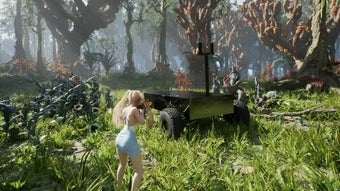
Visual identity mixes realistic 3D environments with high-quality anime-style character models and customization. Third-person shooter combat is integrated with RPG progression, so camera perspective and animations directly affect aim and movement during encounters. Interface details are not fully disclosed, but the combination of deep building systems and character customization suggests menus that must handle inventory, base layouts, and Pva management without breaking immersion.
Is it hard to get started and what about progression?
Early play demands attention to multiple systems: base construction, Pva management, and vehicle piloting for the mobile base. The developer lists RPG progression elements and deep building systems, which implies a measurable learning curve for players who prefer immediate action. The game is in pre-release development, so onboarding and tutorial quality are not yet established; players who enjoy systems-heavy survival play should expect an involved ramp-up.
Solaria suits players who favour methodical, systems-driven survival
Solaria is a measured choice for players who enjoy planning, automation, and strategic mobility rather than quick arcade action. The single-player focus and complex systems reward careful play, but the project’s ambitious scope under a solo-developer model introduces execution risk. For those willing to invest time in systems management, the game promises depth; players seeking immediate, uncomplicated sessions should consider whether that depth matches their playstyle.
Pros
Collectible Pvas automate farming, crafting, and combat tasks
Pilotable mobile base enables nomadic exploration and resource transfer
High-quality 3D anime-style character models and customization
Deep base-construction systems support complex player projects
Cons
Single-player only, no multiplayer modes
Project scope is ambitious for a solo developer
Pre-release state leaves onboarding and polish uncertain
Learning curve from layered systems and base management
Laws concerning the use of this software vary from country to country. We do not encourage or condone the use of this program if it is in violation of these laws. Softonic may receive a referral fee if you click or buy any of the products featured here.



.png)